Kecek-Kecek

On Trengganuspeak and the Spirit of Trengganu

Tuesday, September 08, 2009

Folk Who Live on the Shore

The coastal edge of our part of town laid flat against the sea's edge, with strong winds blowing in our face for most of the hot season and then the long blasts of the monsoon gale during the end of year, that brought in lashes of spray and the roar of the sea in turmoil. Bukit Putri stood like a paperweight over the thin green of Padang Malaya, and distant coconut trees in Tanjong Mengabang waved and curled in the blowing wind, as the market of Kedai Payang became just a blur in the pouring rain, oblivious to the flashing beacon on the hilltop that winked to ships at sea.

Sometimes our tall house swayed a little in the incoming storm, when the nipah roof over our kitchen became entangled in the swoop of the wind to let in lightning flashes from the rumbling sky. We were all at the brink, a part known to us as Ujong Tanjong, the edge of land and the beginning of the sea. On calm days, folk stopped at the coffee shed of Köhéng and then later, Wang Ndok's, on the calm edge of the lagoon that stood between us and the shore. On calm days, Che Ngöh Buloh sank his feet in the brackish mud, to make rafts of sasök split bamboo that were widely used in Tanjong as fencing material. Bamboo and mud and heaps of dark grit left by mud skippers in this playground of the ikang ddukang [belukang to posh folk from Western shores], a fish with a sharp needle standing proud on its dorsal; fish and bamboo and skippers and mud all worked together to give this part a peculiar pong that became the stenchmark of these bamboo weavers.

We had many artisans in our Tanjong, but Wang Ndok was our artist who, one calm night just after Hari Raya, stood on the stage specially built on oil barrels on the shore and surprised us all with his performance of a modern homespun melodrama. Later in life, soon after Köhéng had put all his thick tea cups and saucers into a box and into storage, Wang Ndok surprised us all again by exorcising the thespian spirit from his body and filled into the gap a penchant for tèh. He sold tèh tarik and pulut lepa and beleda set in little glasses, and kopi-oh and Milo in a steaming mix of condensed milk and sugar in his shed of corrugated iron on the shore.

This was the back-end of Tanjong Pasar, which is no more, where our kinsman Kör played marathon matches of dam [draughts] with friends and complete strangers on the low veranda of his house and stopped only when the cockerels came out to crow and the fishermen were pushing their boats out into the red glow of dawn at sea. His younger brother Mat returned from there long before I became aware of anything, and then he was out there not as a fisherman but as a man of the merchant navy. Much later in life, when he was still gadding about in the khaki shorts of his maritime life, he came to live under the front stairs of our house, a corner that he shared with uncle Retnam, lime pickle-maker extraordinaire and retired linesman from Father's Telecoms Office near Jalan Banggol.

Che Ngöh and Kör and Mat and Retnam and Köhéng have long left us, and recently I heard that Wang Ndok too has been taken from this mortal coil. But bits of Tanjong are still there, flapping in the wind that is now blowing less fiercely, but still pinned to the earth, nevertheless, by the weight of Bukit Putri. A large chunk of Ujong Pasir had dropped into the sea aeons ago, and recently, when I was taken on a tour there by Cikgu Wan Chik, my school teacher from Sekoloh Ladang, I saw sad faces and derelict houses, and a society uncared for.

The Trengganu (now Terengganu) government that is flush with oil funds has no plans to improve their lot or keep them there and let them thrive where Wang Ndok once trod the boards, where Che Ngöh Buloh made his pagör sasök and Köhéng poured out cups and cups of tea. Where Mat the sailor came home to shore, where Pök kept his hardware shop, where Kör played dam till folk with goods came from the ulu.

They are even now awaiting the hour to pull down these houses and break down these folks on the shore and then move them all as far away as possible from the sea; and then let in Starbucks and megamalls and car parks and the rumble of 4WDs and tourists in their silly hats that will frighten away the ghouls that are still clinging to the ghostly roots of ancient trees.

See Also:
Jejak Awang Goneng 1 - 5, Start viewing from here.

Labels: , , , , , , , ,

Tuesday, October 07, 2008

Chainlink to Pök’s Family

Where are the wooden slats now Pökof Pök’s shop that were dismantled with a clatter and then re-assembled as the shadows lengthened long after the intense light of noonday. Pök’s was next door to the coffee shop of Wang Wook, a man who sold rice and sugar and salt by the picul in days when he was rival to his kinsman Wang Deramang, who sold much the same stuff in another shop next door to Bhiku’s café. Then, in his later years he turned it into a coffee shop. This was when Wang Deramang was no longer the trader next door also to the house of a man with a long bushy handlebar whom father called Staling, after the Russian dictator, and I thought, as I came across pictures of Stalin in old newspapers, the resemblance was uncanny.

Further down the road, down towards the back of the market was our family member named Kör, horn-rimmed glasses and sarong pelikat worn in an unkempt way of the man of the pantai. Kör was a club-footed man who spent long hours playing draughts (dang as we called it) and lived in his white T-shirt that would’ve come, like tea, from China. It probably had the brand name and the logo of the Pagoda. They called him Kör Tönjèng for obvious reasons, tönjèng being Trengganuspeak for club-foot, though to us he was always Pök Kör. Something makes me think that when he was off his draughts board he was a carpenter with a stained roll of thread wetted in some black dye that he used to mark a line in wood before sawing, and a gimlet that I think we called putör rèla.

A kindly soul with a name too complicated for me to lay down here recently sent me an old family photograph that had in it Pök and Wang Mamak (Wan Muhammad) who kept a photo studio above Pök’s shop where we went to one Hari Raya to have our photo taken by a cardboard looking corinthian pillar. I have, until recently, forgotten about Wang Mamak, but I did and do remember his assistant Sulong who hid under a blanket and projected his photographic lens and bellow towards us when we were told not to blink an eye.

You can read about Pök in GUiT at page 33, under “Nails, Ropes and Old Vinegar”; and Sulong is found on page on page 50, under “Snaps and Studios”. I asked about Pök of my benefactor, and he said that Pök was connected to another Wang Mamak whom we knew as Ayöh Wang [see GUiT, p.35 “Breath of Mettle”], the man who wheezed and whiffed from asthma and made brassware and kerepok lèkör, the Trengganu fish mushed in sago flour, rolled into long ropes and thrown to the boil that Stewart Wavell, in his book “The Naga King’s Daughter”, mistook for sea-creatures. Wang Mamak and Father were luminaries of our local prayer house (surau), he being the chairman of the re-building committee, and Father the treasurer. When they got the appeal leaflets printed in Jawi at the Mansor Press, a little printing shop by the Masjid Abidin, the typesetter laid the letter lam (‘l’) at the start of Wang Mamak’s father’s name (Awang) instead of an alif (ah), so he became to us Wan Muhammad bin Luang, chairman, kerepok and brass maker.

When I re-visited Tanjong last December to January, I looked up Wang Saléng (Wan Salim), Wang Mamak’s son, and was astonished to find, on the wall in front of his house, the graffito “Mamat Sprong”. I choked briefly for my Trengganu Private Dick character Mat Sprong, who, at this moment, is in the ulu somewhere looking for the Sang Kelembai. He may well be part of the Pök family.

You’ve probably seen the photographer Wang Mamak Wan Muhammadremembered through his portrait of another of our GUiT people, Pök Mang, or to give his full name, Raden Lockman bin Raden Saleh. In GUiT, Pök Mang practised his dots and dashes with Father in the front of our house one night, when it went dee-dee-dee-dit— dah-dah [GUiT, p.110, at p.113].

And of Sulong, well, reported my correspondent (well, since you ask, he calls himself Chorkedaggarik Chorkedaggarik, which is a mouthful if Trengganu):
“Sulong..YES..as was told by my auntie..among our family members SULONG known as Sulong Janggut (Allahyarham)..after he left Kg. Tanjung he joined FELDA Jerangau..and operated a small motorcycle workshop...”
Well, I didn’t know that Wang Mamak was the son of another well-known personality of Trengganu, Dato’ Perba, until WangRohing wrote this on my page: “Actually Wan Mohamed Dato' Perba's shop was atop Pök's shop across the road. His partner in the business was Sulong.”. And then came another note, from Wan Ahmad Farid:
“This is news to me. I don't know that the late Wan Mohamed Dato' Perba, my uncle was a photogapher. I counterchecked this with Haji Wan Embong Ismail my 87 year old uncle by marriage and he confirmed that Wan Mohamed was actually running a small photo shop atop Pok's shop. The late Pok was my grand uncle, being the younger brother of my paternal grandmother, Che Wok binti Khatib Salleh. Che' Wok was married to Dato' Perba, my grandfather.
Thanks, Chorkedaggarik Chorkedaggarik, for the photo, and thanks, all of you, for the memory.

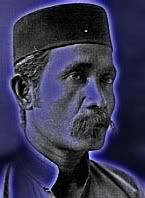
Photos: Top: Pök Che Amat; Bottom: Wan Muhammad Dato' Perba.

Labels: , , , , , , , ,