Kecek-Kecek

On Trengganuspeak and the Spirit of Trengganu

Tuesday, December 20, 2011

Diary of Pök Téng

We have found the diary of Pök Téng, as faithfully recorded by Tuan Wingsteak, an Englishman who left the colonial service to go native in Kuala Trengganu's Ujong Tanjong in the 1950s. He spent his life among the fishermen and enjoyed especially his conversations with Pök Téng, a local odd job man and native sage. We are fortunate that Tuang Wingsteak recorded some of his conversations with Pök Téng in a notebook, found in the glove compartment of his Austin Riley that was donated to the Trengganu Museum (yet to be built) by his next of kin in England when his pen ran out of Quink and he himself finally deceased. Tuang Winsteak, as he was known in Kuala Trengganu, wrote in Jawi in his notebook,
in Pökténgspeak:


December, 20th 1951.

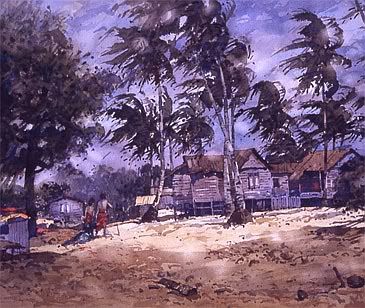
Monsoon in Kuala Terengganu courtesy of Malaysian artist Anuar Dan

Bila dengör ömbök dderu tu naik kemarok pulök, nök makang ikang sarök. Tapi le ning, muséng tutop kuala, ömbök kasör, orang dök kelauk. Napök nye kena dok derumöh je lah, dok makang ubi török. Kalu nök makang pisang tu kena jaga lah sikit, kalu kena pisang dök mölèk tu naik mmulah perok, betang demang. Orang rumöh ambe kata pisang bakorang tu baik kalu beri orang baik demang. Dia tohok sebutir ddalang bara api takdi, pah tu kita makang masa tengöh panas berasap, hilanglah rasa luga, rasa macang nök mmaing rödak pulök.

Muséng turong air ulu ning laok mengaung siang malang, macang bbunyi rima je ssepék ccelöh batang buloh. Kemarèng ada budök pasör tu jereloh ddalang pasir rebih ttepi pata, nasib baik dang ppaok ke dahang pohong bbaru. Kalu dök habislah dia hanyuk ke Pula Rèdang, dudok denge Tuang Puteri, dok dengör Mökyonglah tiap-tiap malang. Tapi ssiang jugök ke dia habih nnelah peha sapa ke lutut. Dia dok nnönènglah di dahang pohong tu takdi sapa orang gi ambek denge perahu jalor buat naik ddarak.

Nök gi dok ttepi pata pong gerung le ning sebab anging kuat bawök masok macang-macang benda atah tebing. Kalu ssilap dok ccakong ttepi pata tu kena buöh rengas, ssiaplah sariyang pulök dok ggaru punggong. Le ning napök nye kenalah gi buang air ddalang rök sebab takut tèngök tebing dok rebih. Lagi pong anging nniuk kuak sangak, ssilap buak, kaing ssahang pulök kena tiup di anging, ssèlok lah napok seluör kkatök.

Kerepok lèkör pong takdok setarang muséng ggining, maklong sajalah muséng ömbök kasör ning örang dök gi kelaut, Mök Song pong dök gètèl kerepok.. Hök ada kerepok kering je, tapi nök görèng minyök nyor takdök setitik hharang, habis Sèmèk tu nye buat minyök rambot. Napök nye kena gi ppatalah ambik pasir halus dua tiga cètöng nök buboh ddalang kuali, bila panah tu mölèk jugök buleh görèng kerepok. Natilah dulu, hujang dok turong ning, pasir pong tengöh basöh jjerok.

Mölèklah dok derumöh petang ggining, kalu ada rizki dapak makang ubi kayu denge nyör parok. Lepah kena air kawa segelah gök jatoh ddebing selalu lah, tidor sapa ggarék .

* * *


Kita ssètök sapa jatoh ppale dari nyör kömèng, ingaknye guroh bbunying dari lauk. Bila buka mata baru napök bumi gelak gelemak, api lak dari atah Bukit Tteri nnyala lik-lik dari jaoh, bunyi dari Sura Haji Mat Kerici tulah yang jadi ambe ssètök. Budök-budök pasör le ning takdök kereja serema sebab ikang dök naik, nye dok kkupol ddalang sura, pah tu nye beratang pukol geduk. Habih rèng nye pepöh kulit lembu tu, dengör sapa ddarak.

Dalang dok jjalang balik tu jeremböng denge Mèk Munöh dok tengöh kutip kayu api ttepi pata. Kita teringat nök kkabör kerepok hok ambe beli dari dia dulu tu dök mölèk. Kita kata ikang tu gatal tapi sebab anging kuat dia silap dengör, nye bedal ppale kita denge peranyöh.

"Bukang ambe kata mung Mèk, tapi kerepok tu yang gata." Tapi bila muka dia masang ccatung tu dia wak dök je apa hok ambe cakak.

Bila balik nök cerita guane ke orang rumöh, döhlah ppale mèröh mmerang, nye ddenyuk pulök macang kena sengak ikang ddukang. "Ba'pe yang muka mung bekök nnötöng, tu Yaténg?" orang rumöh kita tanye sambil tangang dia dok ayök tepong nök wak kuih bèke.

"Döh nök wak guane," kita jawak. "Bila jjalang ttepi pata ta'di kita ssèmbak tali sauh Wang Mang. Jatoh gguling bating, teratok ppala bbira wakaf."

"Tulah mung dök semayang ggarék," dia jawak. "Orang gi semayang mung dok nnètèr ttepi laok!"

[For translation, go here]

Labels: , ,

Wednesday, June 30, 2010

A Long Way From the Shore

While walking in West London this morning something astonishing appeared in my footstep. I recognised it at once as the buöh gömök of Old Trengganu, as we used to collect from the shore of Ujong Tanjong among the debris brought down by the waters from upstream, and then washed ashore by the waves at the kuala.

I don't know how this buöh gömök came to West London, but looking at it closely I saw that an eyelet had been embedded into it to take a string or lanyard. In fact, if you look closely at the photo you'll see there a bit of string still, so I suspect that this seed has been swung around, served as a pendant, or has knocked many times against another in the manner of ye old British conkers. It may have been brought here by someone from the West Indies, or it could have dropped from the pocket of a passing East Coast Malaysian (Pak Zawi?), or someone who's been to a US department store.

The buöh gömök is what's called buöh beluru in Kelantan (as I was told by Pak Zawi), and in Trengganu I suspect that mighty gömök trees grew along the riverbanks, upstream in the ulu where nobody but woodcutters and the Sang Kelambai ventured to go. If you see woodcutters in the wild, do, by all means, say hello, but if an elderly woman crosses your path in the woods, never give her the time of day, as she may be the Sang Kelembai whose glare will petrify you. And there you shall be, under the gömök tree, immobilised and unrescued, for ever more.

This gömök seed is a native of the old world tropics that embrace parts of India, the Philippine islands and the Nusantara, as well as some parts of China. Botanically it is known as Entada phaseoloides, and it has cousins and brothers in Africa (where it is known as E. rheedei) and in the New World (E. gigas). The gigas variety is hard and shiny brown just like our gömök but is also intriguingly heart-shaped. The entada comes in seed pods, much like our petai (Parkia speciosa ), and the Entada gigas holds the record for having the world's longest pod, some stretching to six feet in length.

Entada seeds must be among the world's most resilient. The heart-shaped gigas, coming adrift from South America, are carried by the currents to shores as far away as Norway. The phaseoloides visited us in Tanjong after being knocked about in the spiralling waters in the monsoon months, and in the United States, phaseoloides and rheedi seeds are sold in department stores, for use as anchoring base for dry flower arrangements, and as playthings for young minds uncorrupted by computer games and the telly. In Trengganu we picked these seeds from the shore, we spat on them and polished them and filled them with lead, and we used them as our kör.

The kernel of the gömök is used for medicine in many cultures, and the African variety, the rheedei, is also known as the Dream Seed for the hallucinogenic inducing properties of its kernel. In Tanjong we used to bore a hole on the side of the E. phaseoloides with a gimlet (ggörèk) and we'd leave the seed out overnight for ants to feed on and probably get high to the eyeballs on the kernel. The empty shell is then filled with heavy metal, long before heavy metal became the anthem of the sozzled.

Kernel Note: Please don't try anything suggested in the last paragraph at home as the results may scare you more than the petrifying stare of Sang Kelembai.

Labels: , , , , ,

Tuesday, September 08, 2009

Folk Who Live on the Shore

The coastal edge of our part of town laid flat against the sea's edge, with strong winds blowing in our face for most of the hot season and then the long blasts of the monsoon gale during the end of year, that brought in lashes of spray and the roar of the sea in turmoil. Bukit Putri stood like a paperweight over the thin green of Padang Malaya, and distant coconut trees in Tanjong Mengabang waved and curled in the blowing wind, as the market of Kedai Payang became just a blur in the pouring rain, oblivious to the flashing beacon on the hilltop that winked to ships at sea.

Sometimes our tall house swayed a little in the incoming storm, when the nipah roof over our kitchen became entangled in the swoop of the wind to let in lightning flashes from the rumbling sky. We were all at the brink, a part known to us as Ujong Tanjong, the edge of land and the beginning of the sea. On calm days, folk stopped at the coffee shed of Köhéng and then later, Wang Ndok's, on the calm edge of the lagoon that stood between us and the shore. On calm days, Che Ngöh Buloh sank his feet in the brackish mud, to make rafts of sasök split bamboo that were widely used in Tanjong as fencing material. Bamboo and mud and heaps of dark grit left by mud skippers in this playground of the ikang ddukang [belukang to posh folk from Western shores], a fish with a sharp needle standing proud on its dorsal; fish and bamboo and skippers and mud all worked together to give this part a peculiar pong that became the stenchmark of these bamboo weavers.

We had many artisans in our Tanjong, but Wang Ndok was our artist who, one calm night just after Hari Raya, stood on the stage specially built on oil barrels on the shore and surprised us all with his performance of a modern homespun melodrama. Later in life, soon after Köhéng had put all his thick tea cups and saucers into a box and into storage, Wang Ndok surprised us all again by exorcising the thespian spirit from his body and filled into the gap a penchant for tèh. He sold tèh tarik and pulut lepa and beleda set in little glasses, and kopi-oh and Milo in a steaming mix of condensed milk and sugar in his shed of corrugated iron on the shore.

This was the back-end of Tanjong Pasar, which is no more, where our kinsman Kör played marathon matches of dam [draughts] with friends and complete strangers on the low veranda of his house and stopped only when the cockerels came out to crow and the fishermen were pushing their boats out into the red glow of dawn at sea. His younger brother Mat returned from there long before I became aware of anything, and then he was out there not as a fisherman but as a man of the merchant navy. Much later in life, when he was still gadding about in the khaki shorts of his maritime life, he came to live under the front stairs of our house, a corner that he shared with uncle Retnam, lime pickle-maker extraordinaire and retired linesman from Father's Telecoms Office near Jalan Banggol.

Che Ngöh and Kör and Mat and Retnam and Köhéng have long left us, and recently I heard that Wang Ndok too has been taken from this mortal coil. But bits of Tanjong are still there, flapping in the wind that is now blowing less fiercely, but still pinned to the earth, nevertheless, by the weight of Bukit Putri. A large chunk of Ujong Pasir had dropped into the sea aeons ago, and recently, when I was taken on a tour there by Cikgu Wan Chik, my school teacher from Sekoloh Ladang, I saw sad faces and derelict houses, and a society uncared for.

The Trengganu (now Terengganu) government that is flush with oil funds has no plans to improve their lot or keep them there and let them thrive where Wang Ndok once trod the boards, where Che Ngöh Buloh made his pagör sasök and Köhéng poured out cups and cups of tea. Where Mat the sailor came home to shore, where Pök kept his hardware shop, where Kör played dam till folk with goods came from the ulu.

They are even now awaiting the hour to pull down these houses and break down these folks on the shore and then move them all as far away as possible from the sea; and then let in Starbucks and megamalls and car parks and the rumble of 4WDs and tourists in their silly hats that will frighten away the ghouls that are still clinging to the ghostly roots of ancient trees.

See Also:
Jejak Awang Goneng 1 - 5, Start viewing from here.

Labels: , , , , , , , ,