Kecek-Kecek

On Trengganuspeak and the Spirit of Trengganu

Thursday, April 22, 2010

Music in the Isle

Time flies, water flows, the sun sets and the moon rises. But the music goes on.
This is an old picture, again from the family album of my friend Chorekdaggarik who also sent us that delightful picture of women cycling in Chendering that I blogged about in Les Bicyclettes de Chendering.

This photograph was taken in February 1956, on an island just off Pulau Duyung. It touches me in many ways, not least because one of the persons in this photograph, the man fiddling on the left, is Wan Muhammad Dato' Perba, the photographer who set up his photo studio above Pök's shop [see, Snaps and Studios, GUiT, p.50;  "Nails, Ropes and Old Vinegar", p. 33], just a stone's throw from our house. I never threw stones at Pök's, I promise you, but we went there for odds and sods - nails, fishing hooks, bits of string and sometimes just for a chat. Pök was a genial man whose shop reeked of vinegar that he kept in clay pots in the back. He once sold my brother a hook and line and told him to go to the Sekölöh Paya Bunga (Paya Bunga School) for the rod. The school then had a hedge of thin bamboos.

We have many photographs in our family album taken at Wan Mohammad's photo studio with its cardboard Greek columns and the full moon backdrop.

The photograph also touches me in another way. In the back of the photo is this inscription:

It says, "Berkelah di Pulau Belakang Pulau Duyung pada 3/2/56 sekelian famili Dato' Perba dan Encik Omar, bèsangnya. Ahli-ahli muzik sahaja."

"Picnic on the island behind Pulau Duyung on 3/2/56, the entire family of Datuk Perba and Encik Omar, his bèsang. Musicians only."

Bèsang is the Trengganuspeak rendition of bèsan, a relationship that has no equivalent in English. He or she is the person whose child is married to one of yours.

Early mornings I used to look out from the windows of the front of our Tanjong house, to the activities in the market. Below us was a shop, run by a man named Haji Nik (we called him Ayöh Nik) and a very amusing and witty man we called Che Awang who could draw and tell jokes and do conjuring tricks. Che Awang was from the family of Dato' Amar (the Man of Oob in GUiT) and Ayöh Nik was one of the children of Encik Omar, but I doubt if he is in the photograph as he was a no-nonsense man not given to much music.

Thank you Chorekdaggarik for sharing with us this wonderful photograph.

Read Also:
Chainlink to Pok's Family

Labels: , , , , , ,

Saturday, October 18, 2008

Springtime in Little Lane

Opposite the lamp-post where Haji Chik the Unhinged posted his daily diatribes in little hand-written Jawi notes in front of Pök Löh’s coffee shop, was a small lane that cut a swath between a little shack and Pök’s hardware shop. The shack was a closed-door place, with shabby unpainted wooden panels exposed to heat and rain and through its roof of atap came, on cauldron days, the smoke and heat from Pök Löh’s kitchen, smoke billowing from the wood fire and the aroma of dhall stewing in salt and turmeric, and bits of meat bubbling in a sea of murky sauce.

At the signal from the chef, a minion of Pök Löh would cross the road and pirouette his way back with a huge cauldron of bubbly liquid that held dhall or meat, hands insulated from the hot pot by a wrap of long cloth that had seen better days as a coil on someone’s head. Kitchen to shop would have taken three minutes, but dodging the traffic was the art: a couple of trishaws peddling punters to the market, maybe, or a middleman from the fish trade, trundling on his heavy ‘gentleman’s’ bicycle to the afternoon session under the casuarina trees in Ladang, or the odd motor car that bore the ‘T’ of the Trengganu (and Kelantan) number plate.

Pök Löh beside his roti griddle, gave his dark look across the road, praying that his roti dip would not spill onto the road, or the many slips ‘twixt pot and lip would not take place and spray into the passing traffic the many micro-organisms that made the flavour and the deep secret of his primeval sauce that had lain in the bottom of the pot since time began, and topped up and topped up each day as the level sank to the shallow depths. I am happy to record that no such mishaps occurred in my days in Tanjong, or in the days after that.

Back then to the other side of the road, past Pök Löh’s shack, and into the long lane that led — I think — to Kampung Laut. My brother said recently that he learnt to tie the line to the fish-hook from Pök in his hardware shop, and then, for the rod, Pök would say to him, “Mung gi ambék dari pagör sekölöh Paya Bunga.”* Well, this would have been one of the routes to that.

There, some ten yards from the planks that covered the depth of drain that marked the T-junction of the lorong (lane) and Jalan Pantai (now Jalan Sultan Zainal Abidin) of Pök’s and Pök Löh’s shops, was a house on low stilts that, like many kampung houses then, had its front part exposed as a verandah for occupants to sit and watch the passers-by, or as a reception area for guests who had just washed their feet and are now climbing the ladder-like stairs of the house.

In this apron of the house in the lane of no name was a woman who could not have risen easily from where she sat. She was called — out of her hearing distance — Mök Téh Spréng, and you may have guessed that spréng is Trengganuspeak for ‘spring’, the coil and cushion that takes motion and translates it into a continuously bobbing up and down beat. Mök Téh sat there, flesh and person, most afternoons, and worked halves of green papaya with her scraper that produced thin strands of papaya thread. The big woman Mök Téh, flabby arms and heavywight, sitting on an isle of flesh, moving and scraping and bobbing up and down before a pile of papaya shreds. It made many grown up men drool and weep.

Mök Téh’s was the house of Tanjong’s famous röjök beték, green papaya in a vinegary sauce of fish and chilli, and salt and sugar added to taste. It was eaten with fingers, but not quite, for beside her was a glass jar of kerepok, fish crackers dried in the Trengganu sun and fried till they curled – to scoop out the papaya and the fish pounded into the sauce that was at once sweet and hot, in the bowl served in the home-front shop. Mök Téh was a woman of constant movement and few words. She sat there and scraped and looked at the passing trade, and then she’d stir the sauce so the chilli would rise with an extra kick. For that and for fifteen sen and a bit more for the kerepok, grown men sighed and young boys wept.

-----------------
* "You go and take it from the (bamboo) hedge of the Paya Bunga School."

Labels: , , , , , ,

Tuesday, October 07, 2008

Chainlink to Pök’s Family

Where are the wooden slats now Pökof Pök’s shop that were dismantled with a clatter and then re-assembled as the shadows lengthened long after the intense light of noonday. Pök’s was next door to the coffee shop of Wang Wook, a man who sold rice and sugar and salt by the picul in days when he was rival to his kinsman Wang Deramang, who sold much the same stuff in another shop next door to Bhiku’s café. Then, in his later years he turned it into a coffee shop. This was when Wang Deramang was no longer the trader next door also to the house of a man with a long bushy handlebar whom father called Staling, after the Russian dictator, and I thought, as I came across pictures of Stalin in old newspapers, the resemblance was uncanny.

Further down the road, down towards the back of the market was our family member named Kör, horn-rimmed glasses and sarong pelikat worn in an unkempt way of the man of the pantai. Kör was a club-footed man who spent long hours playing draughts (dang as we called it) and lived in his white T-shirt that would’ve come, like tea, from China. It probably had the brand name and the logo of the Pagoda. They called him Kör Tönjèng for obvious reasons, tönjèng being Trengganuspeak for club-foot, though to us he was always Pök Kör. Something makes me think that when he was off his draughts board he was a carpenter with a stained roll of thread wetted in some black dye that he used to mark a line in wood before sawing, and a gimlet that I think we called putör rèla.

A kindly soul with a name too complicated for me to lay down here recently sent me an old family photograph that had in it Pök and Wang Mamak (Wan Muhammad) who kept a photo studio above Pök’s shop where we went to one Hari Raya to have our photo taken by a cardboard looking corinthian pillar. I have, until recently, forgotten about Wang Mamak, but I did and do remember his assistant Sulong who hid under a blanket and projected his photographic lens and bellow towards us when we were told not to blink an eye.

You can read about Pök in GUiT at page 33, under “Nails, Ropes and Old Vinegar”; and Sulong is found on page on page 50, under “Snaps and Studios”. I asked about Pök of my benefactor, and he said that Pök was connected to another Wang Mamak whom we knew as Ayöh Wang [see GUiT, p.35 “Breath of Mettle”], the man who wheezed and whiffed from asthma and made brassware and kerepok lèkör, the Trengganu fish mushed in sago flour, rolled into long ropes and thrown to the boil that Stewart Wavell, in his book “The Naga King’s Daughter”, mistook for sea-creatures. Wang Mamak and Father were luminaries of our local prayer house (surau), he being the chairman of the re-building committee, and Father the treasurer. When they got the appeal leaflets printed in Jawi at the Mansor Press, a little printing shop by the Masjid Abidin, the typesetter laid the letter lam (‘l’) at the start of Wang Mamak’s father’s name (Awang) instead of an alif (ah), so he became to us Wan Muhammad bin Luang, chairman, kerepok and brass maker.

When I re-visited Tanjong last December to January, I looked up Wang Saléng (Wan Salim), Wang Mamak’s son, and was astonished to find, on the wall in front of his house, the graffito “Mamat Sprong”. I choked briefly for my Trengganu Private Dick character Mat Sprong, who, at this moment, is in the ulu somewhere looking for the Sang Kelembai. He may well be part of the Pök family.

You’ve probably seen the photographer Wang Mamak Wan Muhammadremembered through his portrait of another of our GUiT people, Pök Mang, or to give his full name, Raden Lockman bin Raden Saleh. In GUiT, Pök Mang practised his dots and dashes with Father in the front of our house one night, when it went dee-dee-dee-dit— dah-dah [GUiT, p.110, at p.113].

And of Sulong, well, reported my correspondent (well, since you ask, he calls himself Chorkedaggarik Chorkedaggarik, which is a mouthful if Trengganu):
“Sulong..YES..as was told by my auntie..among our family members SULONG known as Sulong Janggut (Allahyarham)..after he left Kg. Tanjung he joined FELDA Jerangau..and operated a small motorcycle workshop...”
Well, I didn’t know that Wang Mamak was the son of another well-known personality of Trengganu, Dato’ Perba, until WangRohing wrote this on my page: “Actually Wan Mohamed Dato' Perba's shop was atop Pök's shop across the road. His partner in the business was Sulong.”. And then came another note, from Wan Ahmad Farid:
“This is news to me. I don't know that the late Wan Mohamed Dato' Perba, my uncle was a photogapher. I counterchecked this with Haji Wan Embong Ismail my 87 year old uncle by marriage and he confirmed that Wan Mohamed was actually running a small photo shop atop Pok's shop. The late Pok was my grand uncle, being the younger brother of my paternal grandmother, Che Wok binti Khatib Salleh. Che' Wok was married to Dato' Perba, my grandfather.
Thanks, Chorkedaggarik Chorkedaggarik, for the photo, and thanks, all of you, for the memory.

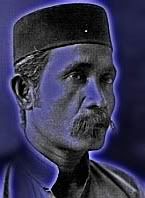
Photos: Top: Pök Che Amat; Bottom: Wan Muhammad Dato' Perba.

Labels: , , , , , , , ,