Kecek-Kecek

On Trengganuspeak and the Spirit of Trengganu

Thursday, April 22, 2010

Music in the Isle

Time flies, water flows, the sun sets and the moon rises. But the music goes on.
This is an old picture, again from the family album of my friend Chorekdaggarik who also sent us that delightful picture of women cycling in Chendering that I blogged about in Les Bicyclettes de Chendering.

This photograph was taken in February 1956, on an island just off Pulau Duyung. It touches me in many ways, not least because one of the persons in this photograph, the man fiddling on the left, is Wan Muhammad Dato' Perba, the photographer who set up his photo studio above Pök's shop [see, Snaps and Studios, GUiT, p.50;  "Nails, Ropes and Old Vinegar", p. 33], just a stone's throw from our house. I never threw stones at Pök's, I promise you, but we went there for odds and sods - nails, fishing hooks, bits of string and sometimes just for a chat. Pök was a genial man whose shop reeked of vinegar that he kept in clay pots in the back. He once sold my brother a hook and line and told him to go to the Sekölöh Paya Bunga (Paya Bunga School) for the rod. The school then had a hedge of thin bamboos.

We have many photographs in our family album taken at Wan Mohammad's photo studio with its cardboard Greek columns and the full moon backdrop.

The photograph also touches me in another way. In the back of the photo is this inscription:

It says, "Berkelah di Pulau Belakang Pulau Duyung pada 3/2/56 sekelian famili Dato' Perba dan Encik Omar, bèsangnya. Ahli-ahli muzik sahaja."

"Picnic on the island behind Pulau Duyung on 3/2/56, the entire family of Datuk Perba and Encik Omar, his bèsang. Musicians only."

Bèsang is the Trengganuspeak rendition of bèsan, a relationship that has no equivalent in English. He or she is the person whose child is married to one of yours.

Early mornings I used to look out from the windows of the front of our Tanjong house, to the activities in the market. Below us was a shop, run by a man named Haji Nik (we called him Ayöh Nik) and a very amusing and witty man we called Che Awang who could draw and tell jokes and do conjuring tricks. Che Awang was from the family of Dato' Amar (the Man of Oob in GUiT) and Ayöh Nik was one of the children of Encik Omar, but I doubt if he is in the photograph as he was a no-nonsense man not given to much music.

Thank you Chorekdaggarik for sharing with us this wonderful photograph.

Read Also:
Chainlink to Pok's Family

Labels: , , , , , ,

Tuesday, October 07, 2008

Chainlink to Pök’s Family

Where are the wooden slats now Pökof Pök’s shop that were dismantled with a clatter and then re-assembled as the shadows lengthened long after the intense light of noonday. Pök’s was next door to the coffee shop of Wang Wook, a man who sold rice and sugar and salt by the picul in days when he was rival to his kinsman Wang Deramang, who sold much the same stuff in another shop next door to Bhiku’s café. Then, in his later years he turned it into a coffee shop. This was when Wang Deramang was no longer the trader next door also to the house of a man with a long bushy handlebar whom father called Staling, after the Russian dictator, and I thought, as I came across pictures of Stalin in old newspapers, the resemblance was uncanny.

Further down the road, down towards the back of the market was our family member named Kör, horn-rimmed glasses and sarong pelikat worn in an unkempt way of the man of the pantai. Kör was a club-footed man who spent long hours playing draughts (dang as we called it) and lived in his white T-shirt that would’ve come, like tea, from China. It probably had the brand name and the logo of the Pagoda. They called him Kör Tönjèng for obvious reasons, tönjèng being Trengganuspeak for club-foot, though to us he was always Pök Kör. Something makes me think that when he was off his draughts board he was a carpenter with a stained roll of thread wetted in some black dye that he used to mark a line in wood before sawing, and a gimlet that I think we called putör rèla.

A kindly soul with a name too complicated for me to lay down here recently sent me an old family photograph that had in it Pök and Wang Mamak (Wan Muhammad) who kept a photo studio above Pök’s shop where we went to one Hari Raya to have our photo taken by a cardboard looking corinthian pillar. I have, until recently, forgotten about Wang Mamak, but I did and do remember his assistant Sulong who hid under a blanket and projected his photographic lens and bellow towards us when we were told not to blink an eye.

You can read about Pök in GUiT at page 33, under “Nails, Ropes and Old Vinegar”; and Sulong is found on page on page 50, under “Snaps and Studios”. I asked about Pök of my benefactor, and he said that Pök was connected to another Wang Mamak whom we knew as Ayöh Wang [see GUiT, p.35 “Breath of Mettle”], the man who wheezed and whiffed from asthma and made brassware and kerepok lèkör, the Trengganu fish mushed in sago flour, rolled into long ropes and thrown to the boil that Stewart Wavell, in his book “The Naga King’s Daughter”, mistook for sea-creatures. Wang Mamak and Father were luminaries of our local prayer house (surau), he being the chairman of the re-building committee, and Father the treasurer. When they got the appeal leaflets printed in Jawi at the Mansor Press, a little printing shop by the Masjid Abidin, the typesetter laid the letter lam (‘l’) at the start of Wang Mamak’s father’s name (Awang) instead of an alif (ah), so he became to us Wan Muhammad bin Luang, chairman, kerepok and brass maker.

When I re-visited Tanjong last December to January, I looked up Wang Saléng (Wan Salim), Wang Mamak’s son, and was astonished to find, on the wall in front of his house, the graffito “Mamat Sprong”. I choked briefly for my Trengganu Private Dick character Mat Sprong, who, at this moment, is in the ulu somewhere looking for the Sang Kelembai. He may well be part of the Pök family.

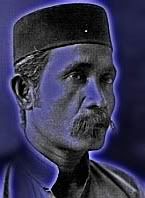
You’ve probably seen the photographer Wang Mamak Wan Muhammadremembered through his portrait of another of our GUiT people, Pök Mang, or to give his full name, Raden Lockman bin Raden Saleh. In GUiT, Pök Mang practised his dots and dashes with Father in the front of our house one night, when it went dee-dee-dee-dit— dah-dah [GUiT, p.110, at p.113].

And of Sulong, well, reported my correspondent (well, since you ask, he calls himself Chorkedaggarik Chorkedaggarik, which is a mouthful if Trengganu):
“Sulong..YES..as was told by my auntie..among our family members SULONG known as Sulong Janggut (Allahyarham)..after he left Kg. Tanjung he joined FELDA Jerangau..and operated a small motorcycle workshop...”
Well, I didn’t know that Wang Mamak was the son of another well-known personality of Trengganu, Dato’ Perba, until WangRohing wrote this on my page: “Actually Wan Mohamed Dato' Perba's shop was atop Pök's shop across the road. His partner in the business was Sulong.”. And then came another note, from Wan Ahmad Farid:
“This is news to me. I don't know that the late Wan Mohamed Dato' Perba, my uncle was a photogapher. I counterchecked this with Haji Wan Embong Ismail my 87 year old uncle by marriage and he confirmed that Wan Mohamed was actually running a small photo shop atop Pok's shop. The late Pok was my grand uncle, being the younger brother of my paternal grandmother, Che Wok binti Khatib Salleh. Che' Wok was married to Dato' Perba, my grandfather.
Thanks, Chorkedaggarik Chorkedaggarik, for the photo, and thanks, all of you, for the memory.

Photos: Top: Pök Che Amat; Bottom: Wan Muhammad Dato' Perba.

Labels: , , , , , , , ,

Sunday, June 22, 2008

More GUiT News

One night, many years ago, as I sat in the front part of our house, the surung as it was called, I heard strange noises and cryptic conversation. I wrote about it in GUiT, under the title “Dee Dee Dit - Dah Dah”, and the man with who was having this strange talk with Father amid the blaring cacophony was Pakcik Lockman, who appeared in GUiT on page 113.

Father, a Morse Code man in the Telegraph Office in Kuala Trengganu, was conversing with Pakcik (Uncle) Lockman in dots and dashes in the front room. These were heady days of technological innovation, when the blanket and smoke, and distant drums, and the cleft stick and carrier pigeons had all given way to copper wires and electricity, and telegraphy was tapped out in Morse to distant time-zones and places afar. I wrote:
”That night a friend of Father’s named Lockman was preparing to sit for his radio ham examination, and he needed Father to brush up his dots and dashes. Dee-dee-dit, dah-dah, dee-dit."
And then, to my great surprise, the past linked back to the present, and it came in an email. And this is how it began:
“...about a month ago I was in Kuala Lumpur. Before returning to Kuantan, my place for the last 48 years I had a brief visit to [my] brother R. Zainal. We had a short discussion about you and how you came to know about me and that I was preparing for my radio HAM examination. I told him that there were only two persons that knew about this. Ripeng, a police wireless operator and Wan Ali (at this time we still did not know that you are the son of 'Ayoh Wang' the man who always smiled when he spoke). My brother couldn’t remember your father. He remembered jovial Wan Daud, Wan Hussain, Wan Jaafar my neighbour, 'Wei Ayoh Ngoh Meroh' his classmate and a few others.”

It was signed simply, 'Pok Mang'.

Pok Mang was of course Pak Cik Lockman, Pok Mangor Raden Lockman bin Raden Saleh to give his full name. In a further email he sent me a black and white photograph of himself looking very much like a matinee star, from his days in Kuala Trengganu, taken, as he said, by Wan Mohamed bin Dato’ Perba, a photographer “who was staying near your house [near] Pasar Tanjong.”

Since the publication of GUiT (now into its 3rd printing) I have had many weird and wonderful experiences, been reunited with many old friends and made many new ones, and heard from quite a few people who told me how GUiT had touched them. But to be able to hear one’s own story once again, this time from one of its protagonists from times past, is a strange experience and a most satisfying one. So I would like to thank Pak Mang for having made contact. He is, I am pleased to say, still hamming it, and is most probably, at 85, “the oldest man [in Malaysia] still active in HAM radio” as he put it. And he’s sent me a cutting to show that from a recent newspaper. Raden LockmanAnd I wish him well.

Labels: , ,