Kecek-Kecek

On Trengganuspeak and the Spirit of Trengganu

Saturday, May 01, 2010

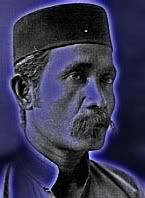
The Man Who Came In From the Sea

From Sulawesi he came to us; he was probably caught in a mighty storm while out fishing at sea, and blown to Trengganu shore.

On land he married a local lady and fathered at least one child. He called himself Bachok, a common name among Bugis men. In Lembing Awang Pulang ke Dayang (Awang's spear returns to Dayang), a tragic tale of disappointment and love lost among the the Bugis (Sulawesi) community in Parit Raja, Muar, in the second half of the 18th century, a man called Awang came home from his travels to marry his love Dayang, but found her on the eve of her marriage, to another guy called Bachok.

Awang turned up at the wedding and stabbed Bachok with a spear that was given to him by the Raja of Bugis. In the throes of death Bachok in turn pierced his best man with it, and the latter passed it on to another, and that person to another and so on until the spear found 99 victims. The last to receive the spear in his body was Dayang's father, who died valiantly while protecting his daughter, and who resisted the spear's demonic will to be passed on to another. And so ended this killing orgy.
In our story in Kuala Trengganu, Bachok appeared from the sea and then married a local girl, and became a part of our community. In life he probably thought often of his native land when he looked out from Tanjong to the South China Sea, but he never once returned to it. According to my brother who went to school with his son, towards the end of his life Bachok expressed a desire to visit his village in Sulawesi once more, but he died soon after and was buried in Kuala Trengganu.

He lived close to the shore and often walked past our house on his way to the pasar (the Tanjong market). His attire was the trademark of our brawn brigade, men whose work deployed and developed their muscles. He wore khaki shorts, and wrapped a sarong over it that hung like a skirt above his knees. Then a cummerbund of another sarong around the waist, and a head-wrap that we in the East Coast knew as the semutar. He was shirtless on hot days, and wore a T-shirt in cool weather.

One day he stopped in front of our house with a sharp golokin his waistband. "Stand back!" he warned everybody, as he scaled a tall coconut tree right to the top, as effortlessly as if the trunk was lying horizontal. And then from the top would come down coconut leaves, the spear-like shoot, the soft heart of the palm, and coconuts began to bounce at the foot of the tree.

With his legs wrapped to the trunk, Bachok would chop off a section of the tree, and then he'd moved down and lop off another, and so on in his descent until he reached the ground and the coconut tree was no more. He'd put the golok back to his waist-band as he moved about to put all the bits and pieces of the former tree into a pile.

And that's what Bachok did for us, he was the feller of our ailing coconut tree.

Photo courtesy of Ajidoel.

Labels: , , , ,

Sunday, September 21, 2008

Boomtime Hills

The genta that clanged at sunset to signal the breaking of the fast (iftar) during Ramadhan was once the amok alarm. I don't know if the people of Trengganu were amok prone, but the last amok in folk memory happened probably in the early years of the last century. He was known as Pök Mat Ngammok (Pak Mat the amok), who, after some unhappiness in his domestic life, went completely out of control. We were told, in bedtime stories in our childhood days, that he was shot and buried under the coconut trees by the shore, in a place called Tanjong Mengabang, which in our day, was also known as Ladang Batu Satu after the milestone before the bend in the road that took us to the Ladang of the two schools and the roundabout of the turtle.

The genta rang bells in many memories [see The Sound of Heavy Metal, below] especially as it is now puasa, the fasting month. But what's unsettled in my mind is the cannon that boomed from distant hills. We were shoreline people in Tanjong, ever looking out to sea and the Bukit Putri, and the hill did the same too, looking to the sails and flags of ships in the horizon that brought to us Admiral Cheng Ho (Zheng He). But that was a long time before the genta clanged or the cannon boomed on the hill. But which hill? Looking to the hinterland from the shore I always thought that it was Bukit Besar (Big Hill) that gave our bbuka time its flavour of the 1812 Overture. But Syafiq, so proud of his corner of town that he has spelt it out in capitals, a BUKIT BESAR BOY, [see Comments, below] puts the blame on neighbouring Bukit Kecik or Bukit Kecil (the Small Hill), whilst Karim Omar (whose 13-year old daughter writes a fine blog) says it's Bukit Pak Apil. Can anyone help us here?

I am grateful to Wangrohing for having found hasidöh's distant cousin in Ambon, in the Maluku (Moluccas) archipelago where the natives have been chomping on it since — perhaps — time immemorial. But the introduction of hasida kantang intrigues me, would that be like sweet, greasy mashed potatoes? But hasida is defined by Chaumont Devin, compiler of the Ambon Dictionary as “ a sweetmeat made of raw dough, sugar and spices”; that's hasidöh to the core. Speaking of Ambonese, these other hasidöh people remind me of Bachok, our agile coconut tree cutter of Tanjong Pantai. Bachok, from Celebes, to the West of the Moluccas archipelago, came adrift to our shore in his boat and stayed with us till the end of his days. How he must have longed for his faraway home, and when he saw our hasidöh did we see a hint of a tear in his eye?

For more hasidöh memories, please go to Comments, but afore ye go please remember that hasidöh the sweetmeat is not qasidah that sometimes wended its tuneful way on Radio Malaysia with its “Ya lail, ya lail, ya lail.....” (“O night, o night, o night...”) in the Songs of the Desert slot.

For the photo below I am grateful to Ajideol of Kolang who sent it with his caption to salute the youth of Pulau Wang Mang and in memory of Bachok, the great Sulawesi man who lived among us and our coconut trees. Thanks Ajidoel. Thanks everyone for your memories. Selamat Berpuasa!

Labels: , , , , , , , , ,

Friday, March 23, 2007

Growing Up In Trengganu #793, 616

Sometimes, late afternoon, we’d walk to the water's edge — ujong tanjong — and watch the dots in the horizon or the payangs coming in with the catch. There were barges bobbing up and down in the busy waters, the rivermouth that put the kuala in Kuala Trengganu. And Cik Jusoh the beachcomber walked past us with twigs and sticks in his hands, picked as they were washed on to the shore.

Cik Soh as we called him, was in mufti which was unlike the clothes that he wore to the mosque. In the former he had a coil of rag on his head and a tattered sarong around the waist, the kaing ssahang that Trengganu males hung on the nail stuck in the wall, or on the wire stretched taut across the verandah as an all-purpose clothes hanger. The ssahang was casual wear for days when we couldn’t be bothered with the sarong and shirt and the songkok at a jaunty angle. It was a one piece item of apparel that covered your parts from the navel down to just below the knee. The head piece was another rag, rolled like a snake of faded batik that coiled placidly over the brow.

In his foraging work Cik Soh struck an interesting pose, his trunk bent slightly forward, and his hands crossed at the wrists behind his back. In this manner he held two driftwoods or three in his hands that were kept away from his body or clothes because Cik Soh, in his eccentricity, had a clinical dread of the unclean parts of his body, like his feet, or the dust of common people. He kept himself to himself and parts of himself from himself, and rarely spoke to other people for fear of being touched. Standing now against the setting sun, with his hands pulled to his back, he was a big, dark praying-mantis silhouette figure.

The day’s end pushed our Tanjong people to the water, to earn their keep from the incoming payang boats or to sit and enjoy the buzz of work. Driftwood provided fuel for domestic fires and children threw sticks and dug holes and chased crabs that waved then bolted to their tiny holes as the waves came back, sending the kids back to the sandy mounds, zig-zagging between adults on their haunches, their sarongs loosened at the waist then pulled to the top. “Jjalang mmolek bila gi ppata,” they used to warn the freewheeling novitiates, “Tread carefully when you’re on the beach” for those burqaed squatting men (and sometimes women) were using the beach as one big toilet in the open air.

We’d find a safe place to sit when the light began to fade and sometimes we spoke to a woman who waved a hurricane lamp to a dot of light at sea. As if by magic the beam of light would twinkle back, and she’d wave again with a contented chuckle. Her husband was pilot on the ship that was coming into the kuala with trade from the godowns of Singapore. We had many men in Trengganu who wore their job descriptions with their names, one such that I can still remember is Pak Ali Pailét, but in this instance I’m not sure if it was he.

The beach was a blessing to us and a fear. On some nights when the moon pulled in the tides, our Tamil shopkeepers pulled their sarongs up to a decent level for them to wade in and rescue merchandise from the water. In his youth, Father said, he used to squeeze lime juice on his freshly shorn head to get the extra head-chilling oomph from the sea breeze blowing on-shore. We had heaps of twigs and the buah rengas coming in when the sea was rough, as the waves lapped in with a mighty roar. There were dead cows and lengths of rope and the gömök seed that we used for kör in children’s games, and long tendrils called rumput jjulok that had a pulpy core that we dipped in ink before shaping into pretty flowers. A crowd gathered one day in the back corner of the market to leer at a dead body that was washed into the teluk. And then a boat came adrift one day, blown by the monsoon winds from the distant shores of Sulawesi. With it came a mighty man we called Bachök who liked us and stayed to father a son called Mat who went to school with my brother. When, in his old age, Bachök expressed a wish to go back to the shore from where he blew into our midst, the hold of Kampung Tanjong was already so firm on him that he stayed on to be laid finally to rest in the earth of Kuala Trengganu.

The shore that Bachök came to is no more, washed out in bits and drabs into the sea by the changing flows and pulls of the water. Ujung Tanjong as we knew it is now submerged like some lost kingdoms under the sea, and sometimes I even wonder if people still do the squat on the sandy dunes of our pantai.

Labels: , , , ,