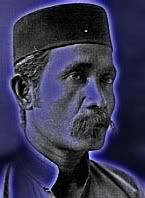
Land of Our Grandfather
In a way, it was grandfather who laid the foundation
 to the Madrasah Sultan Zain al 'Abidin, next door to the first school that I went to, Sekolah Melayu Ladang. I was not yet then of schooling age, but Father had a friend who was a teacher, so he got me a place in Sekölöh Ladang in a class that was an outhouse parallel to the road. Not being on the school's register I had my own privileges, like going to school in my own time of day, but even this privilege did not shield me from the 'dresser' in white who came to school to give us all a BCG jab on the shoulder, where I carry a scar to this day.
Later Father found another friend among the teaching staff of the Madrasah Sultan Zain al 'Abidin, the Arabic school next door, so needless to say, he found me a place there too, under the watchful eye of Ustaz Lob, and a man who, as rumour had it, fell off a camel during his Middle Eastern university days who went by the name of Ustaz Yahya. I was useless in Arabic, and even more clueless when it came to reading the texts. But I remember one line from their Arabic reader, “Thahaba fellahin...” [The peasants went...], they went to a place somewhere in Egypt, but I can't remember where, and I remember marching in the mornings in the quadrangle, and quaking when the mudir (headmaster) Sheikh Mahmud Bakarrafie' appeared in his black songkok and his chosen colour of white from neck to toe. I also remember the Saturday afternoon cinema club of Ustaz Imbab, then — and for a long time — the town's finest calligrapher. I surreptitiously quit going to the afternoon Arabic school when my 'real' school in the morning, the Sultan Sulaiman Primary School, sapped more energy from me than I could get from my early morning roti bata; but it wasn't a year before Father found out, but when he did he simply looked at me more in sorrow than in anger, knowing that I was not cut out to be an Arabic scholar.
What I didn't know then was that when I stepped into the Sekölöh Arab and marched in pairs on its quadrangle, I was stepping on land that once belonged to Tok Wan, my grandfather. Tok Wan was a man of many parts — a scholar, a traveller, a magistrate, court registrar, and District Officer. Among his many teachers when he had travelled the length and breadth of Patani, Kelantan and Trengganu to seek instruction were Tuan Haji Abdullah of Losong and Tuan Haji Muhammad Shafi'ei of Kampung Nyiur Kembar.

Grandfather had given his land in Ladang for the Arabic School as a way, perhaps, of returning what he had owed to Kuala Trengganu. Madrasah Sultan Zain al 'Abidin in Ladang is of course the grandfather of all those educational institutions in Trengganu that now bear the name of Kusza.
I remember very little of grandfather even though we saw him in Besut most school holidays. He was an aloof man who suffered no fools, and he had constant visitors coming to see him in his house in Kampung Raja. My brother recently wrote to say that he remembers Tok Wan having visitors who stayed long into the night to hear his take on the kitabs or to read a qasidah with him, perhaps the burda. I remember listening to him in bed, as he led the family in dawn prayer when we went there, and the sound of spray from his lips when he gave his singing birds their early morning shower. And then I used to watch him sit by the window as the day got brighter, when he read his Utusan Melayu. He had a collection of krises and badiks in the house, and other things that I find hard to relate to him: a couple of peti nyanyi and assorted music on vinyl, though I never saw him wind up the gramophone or talk about the vinyl records or hum a tune of R.Azmi. Looking back now I don't think they were his at all.
Tok Wan was born on 21 December 1885 in Pasir Putih, Kelantan. His mother was born in Kampong Atas Tol in Trengganu, into a family that had settled there to escape Siamese persecution in Patani. When the then Sultan of Trengganu took an interest in the woman who was later to be Tok Wan's mother (she was, apparently, an attractive lady) the family once again packed their belongings and sought refuge in Pasir Putih. There the woman that had caught the Sultan's eye was married to Wan Ibrahim, Tok Wan's father.
----------------------------
*One film they screened was “Hawk of the Wilderness”, it played for many weeks, in many chapters.
Labels: Atas Tol, Haji Muhammad Shafe'i, Madrasah Sultan Zainal Abidin, Sekolah melayu Ladang, Sheikh Mahmud Bakarrafie', Tok Wan, Ustaz Imbab, Ustaz Lob, Ustaz Yahya
posted by Awang Goneng @ 3:13 pm
1 Comments