Mass Movements
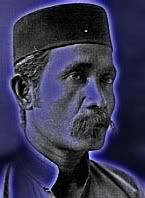
Under the henna tree, on the weather-beaten bench in the compound fenced by a grill of thin metal spears over the low brick wall sat Pök Mud, wizened by time and jangling with a ring of keys that hung from his Haji's belt that was broad and green with pockets for loose change and the odd dollar. Hajis wore that belt to punctuate the middle of their elaborate gear, trousers underneath their kain pelikat dropping to the ankles, and an undershirt of silky material, collar buttoned halfway down the chest in a style that Father sometimes referred to as kanciperat, a word that's as elusive as its flavour's regal. At a wild guess I'd say that it's a marriage between kancing [buttoned] and sekerat, [halfway] from the style of its collar. Over this kanciperat went the baju melayu with its two patched front pockets to dip into when the conversation came to a standstill, and then the turbaned head, tasseled and tailed, that swung round quite breezily when talk turned to raucous laughter.
There were men who wore the kanciperat as de rigueur in Kuala Trengganu, firemen walking around in their off-duty hours wore it too as they loitered in their fenced area in Kampung Daik opposite the 'flowered shop', our kedai bbunga. But Pök Mud wasn't a fireman; he was a genial man and a retired warder as he'd tell you. In his working days he carried a heavy bunch of keys on his belt that held up his regulation trousers in the Kuala Trengganu gaol. I saw Pök Mud on his bench seat under the tree in the compound of the Masjid Abidin for many years before learning the true meaning of that glint in his eye. It transpired that in the last year of his wardering days he took into the prison walls some tiny brightly coloured laxative fruits of a palm tree that was known in Trengganu as buah manjikiang and dosed it liberally into the prisoners' meals. It was the day of the mass breakout of diarrhoea among the inmates of Kuala Trengganu.
Going back two generations or so before Pök Mud, prisoners were lucky to have found food in Trengganu gaols. Walter Skeat, who went on a 'scientific' expedition for the British in 1899 to Trengganu and beyond, illustrated Sultan Zainal Abidin III's 'original mind and a shrewd sense of humour' by his answer to the question why he did not pay off his debts promptly. His creditors would be constantly praying for his continued well-being for as long as they were waiting to be paid, answered the great man, deploying, no doubt, the Trengganu penchant for the leg-pull or mengayör as we call it even now. Unlike other states, Trengganu did not provide free food for its prisoners then; when tackled by Skeat on this matter the Sultan replied, according to Skeat, that if it were so then the entire population of Trengganu would be clamouring to be gaoled.
Pök Mud the prankster warder would have loved the humour even if there wasn't enough manjikiang fruit to set the population going behind those walls.
Labels: buah manjikiang, Kuala Trengganu gaol, Pok Mud, Sultan Zainal Abidin III
posted by Awang Goneng @ 12:02 am
1 Comments