Arms and the Men (and the working women)
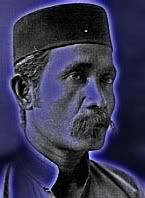
Grandfather had badiks galore and one or two krises, though I never saw him wear any of them beneath the fold in his sarong or carry one or several in his hands when he went out to the shops. In his official photographs as the magistrate of Marang or Kemaman or Batu Rakit he wore a ceremonial sword with his dress uniform, though I was more fearful of the stern look on his face than the weapon in his belt. I never saw the sword in his house though, so it must have been taken, on a short lease, from our local version of the Moss Bros.
Father had a long sword that was his gölök panjang that he never spoke about, and I never saw him wave it in anger or in jest. It was hidden under his four poster bed, and on it were inscriptions in the Jawi script, written in dots, and I think it just said Kuala Trengganu, plus a date. Sometimes he wrapped it in a piece of rag, but when we were moving house, he wrapped it in many pages of a newspaper and sent it (together with our other belongings) to the Pahang Mail Transport Company to be sent to the faraway town of Kuantan where we stayed for a brief period. My late elder brother came home one afternoon when our things were all packed and cleared to say that he’d seen the workers hurling our family gölök like a javelin in the Pahang Mail compound. True to his word, when we saw the gölök again in Kuantan its pointed end had broken off in the form that we in Trengganu would call sumbéng.
When Abdullah Munshi arrived in Kuala Trengganu 170 years ago (in March 1838), he saw men who were not just carrying a mere short knife or the casual kris, but armed to the teeth as they were gadding about in the pasar area of Kampung Laut. "Each man,” said Abdullah, “carrying four or five throwing instruments, and a keris and a long sword; and that's all they do, walking up and down the street carrying their weapons."
 I thought Abdullah had just strayed into a rough spot of town and thought no more of that especially as it happened to be the market place. Mother used to call these rough elements our budök pasör, the street urchins who lived in our Tanjong market, but even then I never saw them carry a knife or even a stick. The only weapons wielded then in the pasar were by fierce looking men called the orang daging (“meat people”, i.e. butchers) and their instrument of choice was the short straight blade that we called the badik, that they pulled from a wooden scabbard kept beneath their waist band — always in the back, close to their spine — to cut the meat.
And then, while looking through my recently acquired copy (which is, alas, in poor shape) of Howard Malcolm’s “Travels in Hindustan, Malaya, Siam and China”, I found this passage about his visit to the town of Tringano :
” The population is about 40,000. The principal product is tin, of which they gather annually about 600,000 pounds. The men not only wear a krees, like other Malays, but often two, and sometimes a sword also; quarrelling much, and working little. Their women do most of the business, and Chinese work the mines.”Howard was a missionary do-gooder who went out from his native America in 1835 in search of fresh fields to conquer and fresh natives to convert. He arrived in Calcutta and Hindoostan in September 1836, and in Tringano (which he described as “a champaign country, of low hills, producing a great variety of delicious fruits”) soon after that, just three years before Abdullah.
Who were these men on the wildside, walking with the clanking of metal in their footsteps and scaring the little kids of men and goats? Were they local vigilantes in the employ of the Sultan to keep the peace?
Photo: Armed men in Bali.
Labels: Abdullah Munshi, badik, Howard Malcolm, kris, Tringano
posted by Awang Goneng @ 12:03 pm
2 Comments