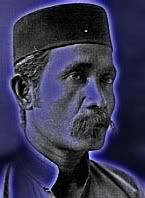
The G-Spot of Trengganu
It is hard not to form the impression that Trengganuspeak is a language in a hurry, eager to impress with little time for linguistic frills. It is the language of working people eager to push the boats out to sea, or of ladies rushing off to market with baskets of fruits or trays of pulok lepa in banana leaf wrappers still steaming from the fire. Anthony Burgess once said that the standardspeak sentence “Seratus orang-orang perang” evokes the noise and image of swashbuckling warriors marching to war. Now hear these Trengganuspeak sentences: ”Hoh, budök ning, aku debök kang baru tau!” Or this description of someone who’s taken flight, “Dia lari sapa kecik ppala!” Both debök [first sentence] and kecik [second sentence] have glottal stop endings, making the former — debo’ — sound just like the thump in the back that it’s meant to be, for it is indeed an onomatopoeia. The second word, keci’ describes so aptly with sound that visual effect of a fleeing person’s head becoming smaller as he makes more distance from his static beholder. He ran until his head began to diminish in the distance, says the speaker.
The prominent characteristics of Trengganuspeak are undoubtedly its tendency to transform terminal Ns and Ms into a hard ‘g’ — makan/makang, baham/bahang, bulan/bulang, malam/malang; and its fondness for contractions: the standardspeak pisang-pisang or mempisang becomes ppisang, bergolek [standardspeak] becomes ggolek, and di pasar [standardspeak] becomes ppasör. You can read more about these shaddah (gemination) words in my earlier blogs Stressed Out Words and Best Foot Forward.
The kecek-Kecek in my blog title is, I must admit, a nod to Standardspeak. It is meant to convey the idea of a light conversation, a soirèe maybe. This at least is the meaning that my worthy commenters [see Comments below] are agreed upon, but applying the device of Trengganuspeak makes the word even more varied and interesting. Kkecek on its own for instance may be just a contraction of the longer standardspeak version, kecek-kecek, with the meaning unaltered. But kecek with the ungeminated ‘k’ can mean ‘persuade’ or, in its extreme form, ‘bamboozle’. When a child is stubborn, a friend will be asked to "Gi gök mung kecek dia sikik", go and persuade him a bit, will you? But a seasoned politician will come not to kecek but to nggecek, to bamboozle.
In a comment many moons ago someone asked what the word kecek-kecek is doing in a page on Trengganuspeak, suggesting that it is more widely used in Kelantan than Trengganu. Perhaps I should concede here that my blood has been coloured in part by the red-dye ssumba (Standardspeak kesumba) that seems to thrive in the sandy earth of my paternal grandparents’, in Besut, on the Kelantan-Trengganu border. But then again, kecek-kecek is used with the same meaning even in those far flung islands of Indonesia where, in some of its even remoter parts, they also transform their ‘m’ or ’n’ endings into the guttural Trengganuspeak ‘g’.
What do you think? Please come in with your comments, which I value greatly.
Labels: Anthony Burgess, kecek-kecek, kkecek, nggecek, shaddah
posted by Awang Goneng @ 10:59 am
7 Comments


 In Trengganuspeak the shaddah is sometimes used to make a verb, as in jjalang (walk), as opposed to jalang (road). But mostly it's used to shorten words, normally those beginning with the prefix ber attached to them in Standardspeak. Here again, jjalang is berjalan in standardspeak, while jalang is someone you don't speak about, well, not in polite company outside Trengganu anyway. The stress also sometimes tells you that there's a preposition amiss, the di word. If you ask someone, Mana Mok mung? ("Where's your Mum?"), and the answer is "Ddunngung," then you know that she's in Dungun (Di Dungun). "Duana mung beli nnatang ning?" ("Where did you buy this thingymathing?"). "Bbesut." But to the question: "Nak gi duane tu wei?" ("Where're you going to?"). The answer could be, "Ppasor." ("To the market.").