Fruits and Needles
When, in the early 1990s, the political administrators of Trengganu woke up with the stilted vision that perhaps people should be evacuated from town centres and despatched immediately to the darat and their homes replaced with roads and shops — a commercial rather than a civic community — one of the houses that got the demolition order within short notice was one that belonged to the family of my uncle’s wife, next door to the Masjid Abidin. This was the beginning of the end of the vibrant community of Kuala Trengganu: its spirit may have gone when the Tuan Putri left the Hill, now it was the turn of the people down below, they were being pushed out by men with moneybags, as hoteliers began to usurp their views.
Seventy-nine years ago, this month, a poem penned by a Trengganu lady named Hajah Wok Aisyah binti al-Haji Nik Idris, had these stanzas:
"Pada masa jalan dibuatnya besarPulling down houses (and people) that stood in the way of progress isn’t something new: it was done during the time of the British Agent/Adviser J.L. Humphreys, the ‘Tuan Hampris’ of the Syair Tuan Hampris that I quote above. Now progress continues apace: Kuala Trengganu is a town with banks and hotels and tourism places and a Cup to catch the Monsoon air, but as with planning in most Malaysian towns nowadays, it isn’t planning for the local community.
Datanglah notis pegawai bandar
Rumah yang terkena ke jalan besar
hendaklah segera pindah beredar
Manakala mendengar notisnya itu
banyaklah orang berhati mutu
Mulut berkata tiadalah tentu
'Inilah akal orang putih itu.'"
"When the roads to be made broader
A letter came from the Town officer
All houses that now stand in the way
Must be pulled down without delay
When word of the notice began to spread
Many people they became so sad
And then they began to natter
'That white man must be behind this matter.'"
Tuan Humphreys wasn’t at all a bad colonial officer: he spoke Malay fluently, played dam with the locals, and even made up for the lack of tact of the High Commissioner the pompous Sir Lawrence Guillemard (who went down to Kuala Trengganu in 1923 with a gong for the Sultan, the KCMG) by translating his high and mighty address into polite and proper court Malay.
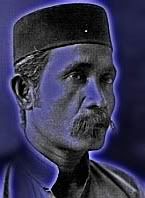
This portrait of Humphreys [left] used to hang
 in the Government administrative offices with that famous clock tower (Jjabak Jang Besör in Trengganuspeak), standing serenely between the wide expanse of old graves of unknown Trengganuers and the padang and the police station of Paya Bunga and the sundial memorial to Humphreys. These offices stood amid clusters of casuarina trees that spread trunks and shed needles and mini spiked fruits on the tarmacked floor. Casuarinas also shielded another place connected with the Kuala Trengganu of J.L. Humphreys, the golf course along Pantai Batu Burok that he gave to the Kuala people.
We used to stop under in the shade of those Jam Besar trees to collect those strange looking mini fruits of the casuarina and to play tricks with their needles. We pulled them out of their joints and then restored them again into intact needles, such were the simple pleasures of childhood in Kuala Trengganu. And then we walked away towards home, leaving the casuarina trees and the clock tower and those government quarters filled with people from states bigger and richer than ours, to emerge in Kampung Kolam by the Istana.
Thinking of this reminds me always of these lines from "Our Casuarina Tree" by that remarkable but tragic 19th century Indian poetess Toru Dutt:
"But not because of its magnificence
Dear is the Casuarina to my soul:
Beneath it we have played; though years may roll,
O sweet companions, loved with love intense,
For your sakes, shall the tree be ever dear!
Blent with your images, it shall arise
In memory, till the hot tears blind mine eyes!
What is that dirge-like murmur that I hear
Like the sea breaking on a shingle-beach?
It is the tree's lament, an eerie speech,
That haply to the unknown land may reach."
See Also:
* Man of Oob
* Light Over Trengganu
Labels: Casuarinas, Hajah Wok Aisyah binti al-Haji Nik Idris, J.L.Humphreys, Pejabat Jam Besar, Syair Tuan Hampris, Toru Dutt
posted by Awang Goneng @ 2:15 pm
0 Comments