24. How To...Tang
Tang is a primeval word that is the stuff of gbh. Sometimes parents use it to warn a child, “Budok ning, aku tang, kang!” (“Don't let me smack you lad!”) and it is often so effective that the lad will soon be quiet, sitting in the corner listening in his head the sound of tang that resounds just like the English smack. So tang like many other basic words in our native tongue, is in the category of the onomatopoeic.
As it is now established that the tang is the sound that became the word, a wide choice is given to us as to the mode of its administration. You can tang with the hand as with a stick, with a stone hurled in the direction of your quarry, or with a blow in the face of an opponent; the last mentioned is especially prized by practitioners as the tang in cheek.
Unlike the tumbok a punch, or the debök, which is the landing of your fist or fingers bunched together into the shape of a bird's beak onto the back of your opponent at great speed, tang lays particular emphasis on the impact, like a stone thrown at an undesirable's house. Now this has a special place in the roll-call of Trengganu's combative arts, and tang of this quality is termed tagor, an act done normally in the quiet long after the sun has set to emphasise its special sound effect. The house is normally that of the orang bujang (unmarried folk), a kampong euphemism for those ladies who flitter about in the dark.
But lest you be mistaken and take tang to be the enforcement of moral values as a nocturnal act, there is no time requirement or place preference for tang, so by practise and common consensus it can be executed at any time of day or night. There are men, but very few women, who are skilled in the art of tang, and they are known variously as kaki tang (practitioners of tang), kaki puko (hitmen) or just simply ppala haliang (trouble makers). The height of their reign was known in Trengganu as jamang tang orang or an era when tang was supreme, the Trengganu version of the Tang Dynasty as prevailed in another land.
There are so many ways of doing the tang as there are practitioners of the art. One mode of operandi that is widely known involves one or several stones hurled in your direction. This is tang done by the petöng, and the recipient, once the stone has landed, say, on the face or some other part of the cranium, is said to be in a state of ddamör, which has no equivalent in the English tongue. Ddamör or bedamör is a mixture of being shocked and swollen and seeing stars and birds suddenly tweeting in the immediate vicinity of your noggin, the antidote for which is a poultice of wet and cold tamarind paste wrapped in a shred of old sarong.
Tang has recently been in the news when a balaclavad British riot policeman hit {tang) a home-going newsvendor with a truncheon, a stick known to us in Trengganu as the ggandeng. The man has since sadly died, and tang by this injudicious use, has acquired a bad name.
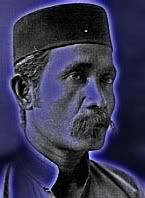
 Some men are immune to tang, one such went by the name of Mamak Ppala Kerah (Hard Headed Muhammad), a recipient of so many tang that had little effect on him beyond making him look, in some light, like Richard Widmark. As we are not all so tang-proofed by birth and without the slightest aspiration to look like Jim Bowie in The Alamo, I'd urge you to be judicious with tang and not practise it in your or on other people's homes.
For a look-back at tagor, see:
Hurlers in the Night
Labels: debök, Mamak Ppala Kerah, petong, Richard Widmark, tago, Tang
posted by Awang Goneng @ 10:03 am
8 Comments