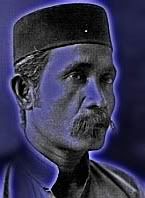
Boy Under A Tree
Budök Bbawöh Pohong
 The kampung idyll shattered by sounds of feet rustling on the dry carpet of leaves. The susurration of a supple branch pulled down low, then released in a swish. An object drops to the ground with the thudding weight of a heavy missile, then the plop! plop! plop! of guavas falling to earth, still-born in their greenness and stone-hard to the core of the fruit.
This was the jambu batu (stone guava) or known simply as jambu butir banyök, the one with many seeds. And then quiet again underneath the tree, until the sound of wooden clogs in garish red, strapped to heavy feet – cracked at heels – by a band of strap in translucent orange plastic. klip-klop! klip-klop! on the metal edge of the road, and then changing to the muffled drumming tone of the earth beneath the clogged feet of Mdme Busybody (Mökcik Ccamèk) now waving an umbrella, as yet unfurled, at a little boy sitting in the jambu shade.
”Ba’ape yang mung dok ketèk jambu tu?” came the first question. Why are you stealing the jambus?
The boy looked at him askance but took another bite from the jambu that he quickly consigned to the shrubs, or rök, as the locals called it.
"Tengok pé’él, ba’pe yang mung dok kereköh jambu putik tu?”. Why are you biting into the unripe fruit? And then, as if in chorus, she came back –
“Kereköh-kereköh, tohok buang. Kereköh-kereköh, tohok buang!” You could put it to song; and dance to it.
The boy sat in the shade and looked at the umbrella lady. Her face glistening in the sunlight filtering through the leaves, her brow sweating from the long walk and the exertion of a one-sided chat.
“Mung jangang ketèk jambu orang tu dök baik. Döh lah mung getuh hök putik, pah tu mung tohok pulök.” Thou shalt not steal, thou shalt not pluck unripe fruit and throw them into the rök.
She unfurled her umbrella, not of the usual green-waxed paper and bamboo stick type, but of a merrier disposition, printed on technicolored fabric, of flowers, stretched over a downward curving radii of metal fingers, more schoolgirl chic than Mökcik.
And then a parting shot, in dire words. “Mung makanglah lagi jambu paca ning, èsök batu mung bekök baru mung serék!” You eat these fruits of a paca tree your testicles will soon swell and drop. [Well, I’ve exaggerated this a bit for effect.]
Now paca was a black adjunct to the horticultural art whose strength lay more in its threats than fact. It was a dangle of empty cans, hung upside down on fruit tree branches, with inscriptions on them that looked like noughts and crosses, most probably written in the lime paste that old ladies rubbed on their siréh (betel-quid) before masticating it in their göbèk. Paca (ritualistic mumbo-jumbo and puff) was used to thwart evil spirits, or the pelèköng forces of kids from the fruits. And pelèköng is not a stone’s throw from a hurled object.
As the grand lady of the payong and clackety-clack clogs (teröpöh) prepared to leave, light shone through leaves and landed and made merry on her umbrella, topped with flowers, as we noted. Mökcik Ccamèk on the underside stood, sweat glistening on her face now lit through a filter so bright, looking radiant and galök.
“If only,” — the boy now thought in his head — “If only I weren’t such a deaf mute I’d be able to tell this lady that she looks almost like the great good fairy of the fruits.”
Illustration: "Dreamer" from the Alexander Kozik Artwork Index. By kind permission.
Labels: betel-quid, jambu, Mokcik Ccamek, paca, sireh
posted by Awang Goneng @ 1:53 pm
2 Comments