Baubles and Buffaloes
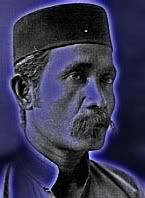
A bluff man with a spring in his step, and he walked with the sway of someone used to marching in the square. His speech a mixture of local parlance and the tongue that we called ccakak luör. And then his gleaming white baju, crisply starched and laundered, shone in the Trengganu light of the noon-day, and he stopped to chat with us — ever the glint in his eye — in the back of the Masjid Abidin that was our gathering place whenever I followed Father to the midday prayer. And then, hoarse in voice but with the clarity of speech that was not in the character of Trengganuspeak, he jested with us kids, and raised his hand — and I’m not sure now if it was his left or his right — to show the stumps of his fingers.
He was, he said, Pak Omar Kudong, the man who waved his stumped fingers on the steps of the mosque in Kuala Trengganu. The missing bits, he said, were lost in battle with Communist terrorists as he waved them again, the kudong parts, the stumps, with pride. I myself preferred to call him Pak Omar Polis, but not quite Mata-Mata, the old-fashioned word for the uniformed brigade in those funny hats with a little black rambutan on top who guided the traffic and arrested petty criminals. Pak Omar Polis lobbed grenades, shot firearms and got shot at, and went home with digits missing in his fingers.
Then one evening on the old playing field of Paya Bunga we looked up to the stage platform built on some rusty oil barrels to see Pak Omar hamming away with a transparent bottle filled with the golden liquid of teh-o. He was swigging away in gay abandon, and muttering and spluttering something incomprehensible, feigning to be in an alcoholic stupor. I could not believe what our Pak Omar of the Masjid was trying to be, even if he was just play-acting a drunken actor. He was too much the Masjid man to me by then, and he was a hero with stumps for fingers.

I think Pak Omar lived in Batas Baru, a police enclave with barracks, and a little patch of green, and a row of shop houses that contained one we knew as Kedai Babu. Babu was a little man of slight build, who was always in his sarong pelikat as he carried out his trade in this backwater of Kuala Trengganu that was part-bucolic and partly humming with the bustle of petty traders: the provision stores, a bicycle shop, a Chinese coffee shop where the locals gathered. At the other end of the road, where it sloped gently down to the padi fields before taking a bend into a little village shaded by trees, was the residential quarter of our school. From this moody gloom under the canopy of hefty merbau trees came the glittering sunlight that made merry on the baubles of stone on the choker and earrings of a formidable cycling lady whom we all knew as Mah Babu.
Batas Baru was another world to us born in the breeze of Tanjong Pantai where no chokered ladies cycled bedecked in stones in the afternoon light or the air filled with the murmur of speech of the police-uniformed orang luar, the outsiders. But this was the world of Pak Omar, and Babu's son Hasan Gemok, and Mr Hamid our school teacher, and water buffaloes that tilled the land and of marshland and dragonflies flitting over water-lilies and purple water hyacinth that hid leeches beneath their shadows.
Recently, soon after GUiT hit the shops, I had a very pleasant surprise when a gentleman — now very senior — whom I wrote about on page 113 as the person who, one night with Father, filled the air of our surung with Morse Code signals, wrote in to tell me what he remembered about Father. And then I asked him in a subsequent eMail about Pak Omar, and he said oh yes, he remembered the man vaguely and if he wasn’t mistaken, the man whom we knew as Pak Omar came to Kuala Trengganu with a group of travelling actors but he stayed on to become a local in Kuala Trengganu.
It brought back to me the night in Paya Bunga, and the amateur dramatics on a now forgotten occasion, and the cold tea swigged from a bottle.
Photo of water buffalo among the water hyacinth from here
Labels: Batas Baru, Hassan Gemok, Kedai Babu, Mah Babu, Mr Hamid, Pak Omar Kudong
posted by Awang Goneng @ 10:58 am
5 Comments