A Prison in Tanjong
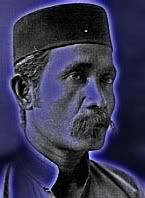
Sultan Zainal Abidin III (1881-1918)was given the posthumous title of Marhum Haji. He was, by all accounts, a devout man whose policy of non-commitment whilst maintaining friendly relations kept both the British and the Siamese at arm's length. Sir Frank Swettenham found him to be "an extraordinarily reserved man, very silent".
Swettenham also noted that for a Sultan, he had little wealth, and he went on to tell a story that he had heard in Trengganu, that on the Sultan's second visit to Bangkok (Zainal Abidin visited Bangkok twice) where he was lavished with presents by the King of Siam –
"he had been told that the Siamese government would lend him $2,000,000 and that he could have $500,000 as advance. This was a large sum to a poor man and it is a credit to him that he declined it."Things were different then.
In a way the Sultan's other-worldliness also disadvantaged his subjects. He left the affairs of state to trusted men, and although himself a just man, he was unaware of many things that were carried out in his name. The administration of justice was entrusted to one Tengku Musa, and in this he was assisted by Tuan Hitam, a Sayyid who also acted as the Sultan's treasurer, and Encik Abdul Rahim, the Sultan's trusted adviser.
Clifford reported that justice was rough, people were imprisoned on scant evidence, and fines were imposed to punish as well as to collect revenue for the court. On April 22nd, 1895, Clifford went to Kedai Tanjong, not to buy fruits or fish, but to visit Kuala Trengganu's penjara (prison). He was appalled by its condition.
"It consists of an enclosure, built in the very centre of the Kedai Tanjong - one of the most crowded positions of the town - surrounding the cages in which the prisoners were confined. The prison is built of heavy slabs of wood, some 3 inches thick, a feet broad and 10 feet high, which are fitted together so as to form a solid wall. Inside this fence, and at a distance of 30 inches from it, are two rows of cages placed back to back, which are made of heavy bars of wood with intervals of a couple of inches or so in every eight for the admission of light and air. These cages are raised about 6 inches from the ground, and measure some 6 feet in length, 2 feet in width, and 5 feet in height."He reported that there were 20 cages in all and during his visit, the penjara was 'fairly full'.
Prisoners were not permitted to leave their cages and sanitary arrangements were non existent. "[T]he space between the floor and the ground, and the interval which separates the cells from the surrounding fence, is therefore a seething mess of excrement and maggots," Clifford wrote.
The closeness of the cells, poor ventilation, and the solid wooden walls all added up to something appalling. "To add to this misery," he added, "no bathing appliance of any kind are supplied to the prisoners, and the filthy persons of the inmates of these cells beggar all description."
Reference:
M. C. ff. Sheppard, "A Short History of Trengganu", JMBRAS Vol. XXii Part 3, June 1949.
Labels: Frank Swettenham, Hugh Clifford, M.C.ff Sheppard, Sultan Zainal Abidin III
posted by Awang Goneng @ 5:42 pm
16 Comments