Light Over Trengganu
How swiftly time flies: a peek at the date and it’s already the eighth day of the new year!
Cepak sunggoh masa jjalang,In 1925, maybe later, they placed an instrument on a raised platform to measure time with light from the sun that travelled over the Trengganu sky. This was near the police station, opposite the Padang Paya Bunga, and not far from the Pejabat Jam Besar (Jjabat Jang Besör in Trengganuspeak) that was hidden a short distance away, in the shades of casuarina trees.
dah nök wak guana setarang!
How swiftly the time it flew
Then there’s nowt that you can do!
Sometimes when we walked home from the Sekölöh Sultang Slemang (the “Rendöh” – Primary – branch of the school), we’d stop by at this monument to peer at the intersecting bits of curled metals, with barely a note of recognition of the person that it was trying not to forget, nor the time of day. This was the sundial of Kuala Trengganu, raised over the ground where once walked J.J.Humphreys.
Humphreys was appointed British agent to the court of Sultan Zain al Abidin in 1915, firstly to share a supporting role with Charlton N.Maxwell, and then to replace him altogether. Maxwell, grandson of Sir William Maxwell of Maxwell Hill, was a Malayan-bred gentleman who was well familiar with native lore; he’d turned his position in Trengganu into a curious anomaly, as an official representative of the British and a member of the Sultan’s Council. The Sultan Zain al Abidin was so impressed with his ways that he appointed Maxwell his mushir, “an obscurity meant to cover over the fact that it was illegal for a non-Moslem to be on the council,” opines Heussler in his book ‘British Rule in Malaya, The Malayan Civil Service and Its Predecessors, 1867-1941’.
Maxwell was soon pulled out of Trengganu to give Humphreys more space to swing his role. He (Maxwell) later retired with his Malay wife to the islands of Dinding off the coast of Perak but sadly, as Heussler notes, they were both murdered by their syce just before the second World War.
I must have seen the photograph below hundreds of times in our family photo album, wondering about the quaint ritual that was taking place (judging from the shadows) in the morning light, and it was not until I went to that school wedged between Batas Baru and Cherong Lanjut that I got to know that it was a sundial erected in memory of one J.J.Humphreys.

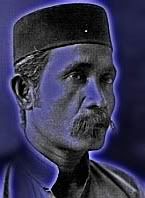
The tall man seen unveiling the sundial in the picture is undoubtedly Sultan Sulaiman Badrul Alam Shah, and from the flag flying behind him — black and white strips, white saltire and star above crescent on white — I would guess that the ceremony took place between 1925 and 1933 when the flag was replaced by another. In the second picture (below), the white-suited man with the pith helmet cupping his hand to catch the light is probably the British Agent, and I’m confident that the man in the black Malay baju, looking with great interest at this new addition to the landmarks of Kuala Trengganu is none other than the Menteri Besar Datuk Seri Amar Diraja Ngah Muhammad bin Yusuf, who, one fine golfing day, gave Humphreys a long memorable lecture on the judgment of Solomon vis-a-vis the claims of two women over a child [see, Man of Oob].

Humphreys was, by all accounts, a tactful man and a competent British Agent credited with the economic progress of Trengganu. He stayed for a long time, until 1925, and is remembered, among other things, as the man who brought golfing to Kuala Trengganu. He died in Tientsin in 1929, from pneumonia, at the age of 50.
Labels: C.N.Maxwell, Datuk Dri Amar Diraja, J.J.Humphreys, Kuala Trengganu Sundial, Sultan Sulaiman Badrul Alam Shah
posted by Awang Goneng @ 12:58 am
1 Comments