The Kerengga Tree
The kerengga tree stood as tall as the house, its fingers grasping the sky. In the morning it trapped light that glistened on its broad leaves, and it made the kerenggas luminescent in their queue to their daily chore of examining jambus and exchanging gossip in the Besut language of the kerengga. As they did this, their antennae waved in search of encroaching enemies that they bit ferociously in the hands or in parts too delicate to tell.
 Kerenggas (Oecophylla smaragdina ) lived in funnel-shaped leaves glued with kerengga glue. They feasted on the juice of the jambu and slept soundly in their nests even when the rain lashed onto this sleepy hollow of Kampung Raja. At the break of the next day's morn we did not see kerenggas strewn into the sodden grass but they were happily queueing up to go about their kerengga ways, carrying shreds of leaves, antennae waving and light shining through their translucent redness and their bird-like heads and dew-drop tummies that were bloating with the fermenting juice of the jambu.
The kerengga had always been there, in the tree with wood so mottled and marked by the feet of young climbers. The kerengga tree bore jambu or the water apple (S. aqueum) that was green or rose red in colour, the latter aptly named the jambu mawar, but in Besut they loved its rose red tint so much they called it the jambu penawar or the healing jambu.
 But our grandfather's kerengga tree bore the green jambu air, just pulp and water in a fruit whose shape would have described the classic Malay nose, had the Malays not preferred to compare theirs to the jasmine flower. On the jambu strutted the biting ants that bit and reeked of formic acid when crushed by an irate kerengga tree climber. We sometimes sat between the tree's branches on the stem that leant backwards, and pretended that we were driving a car. It was the kerengga tree that welcomed us when we arrived from a day's travel from Kuala Trengganu, in an uncle's car, or a taxi that Father hired in Jerteh after we'd disembarked from the Trengganu Bus Company. On many afternoons Father and his brothers and perhaps a distant uncle sat on the covered porch — the anjung — that unfurled above the steps, before the folding-door that opened to the main hall. The morning sun shone brightly through the leaves of the kerengga tree but conversazione time was in the shade on the anjung after asar; and in the nights, with the gentle breeze singing through the leaves when the moondrops painted a ghostly sheen on the jambus, the light and the wind lulled the kerengga to sleep as we formed a semi-circle around Ayöh Ngöh, who was Father's younger brother. The pressure lamp hissed brightly overhead and the Kampung Raja air was quiter in its night than in its day, so we welcomed Ayöh Ngöh's homespun story of his unlikely super hero named Pök Wè.
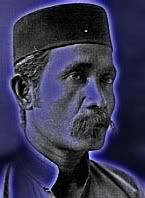
Pök Wè as he appeared to us in between the rustlings of the nocturnal leaves of the kerengga tree was a picaresque character, teeth reddened by years of siréh-chewing, a kain pelikat for his daily wear, with a Malay baju as his top armour and a ppiöh lembèk worn at a jaunty angle. On casual days I imagined him to be coiling his semutar cloth around his head as he rushed to his daily errands, or to chase after a straying buffalo. On Fridays he'd probably put on his baju kot made from khaki material, brass-buttoned, as worn by the peons in government offices during colonial days. Needless to say, Pök Wè lived by his wits and his wind, and the latter we celebrated with a loud cheer as Ayöh Ngöh spun it from the top of his head, with a merry glint in his eye, of how Pök Wè repelled one or several enemies with the blast of his ketok singgang, a resounding fart basted in some home-cooked brew.
I never figured out what Ayöh Ngöh did in his daily life,
 but I could have believed it if he was the real life Pök Wè. He turned up at Grandfather's (his father's) house daily, close to dusk, sometimes in his neat haji's turban and his crisply laundered baju and kain pelikat. A few times we saw him in the market in Jerteh, in the khaki uniform of the trading inspector; he read kitabs and the Utusan Melayu, and had a way of dismissing wayward men and their peccadilloes as if they were comic-strip characters in his daily paper.
And then the light would dim in the lamp above and Ayöh Ngöh would rise and lower its pressure even further to douse out the light completely, and the hall would fade into the semi-darkness of our sleeping hour. Well, I must go now, he'd say as he put Pök Wè to sleep, and then, impervious to our pleadings, he'd open one folding part of the door, and twirl his ppiöh a little on the anjong, and then he'd hem a little under the kerengga tree as he headed for the gate to cycle home to his house by the river.
With thanks:
1. The beautiful kerengga courtesy of A. San Juan, here
2. The kerengga tree photo courtesy of Möh.
Labels: Ayoh Ngoh, Besut, jambu, Kampong Raja, kerengga, Pok We
posted by Awang Goneng @ 1:51 pm
3 Comments